

l_image: parameter. This is how you add watermarks, brand logos, and multi-image compositions in a single URL.
Every layer must end with
fl_layer_apply, which composites the overlay onto the base image. Autorender preserves PNG and WebP transparency in overlays, so logos keep clean edges.How does it work?
You add al_image: block to the transform segment, pointing at the overlay asset’s path, and close it with fl_layer_apply.
Format: l_image:{image_path}
- Basic overlay
- Resized logo (lw_300)
- Watermark (tp_south-east)
- Absolute position (x, y)
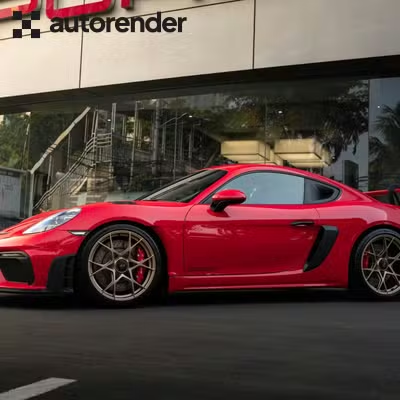



How to size the overlay?
Set the overlay dimensions independently of the base image withlw_ and lh_. Pass one and Autorender scales the other to preserve the overlay’s aspect ratio.
For example,
lw_300 sizes the overlay to 300 px (lw_300) wide and scales its height to match.
How to position the overlay?
Anchor the overlay to a region of the base image withtp_.
For pixel-precise placement, use
x_ and y_ to set the overlay’s coordinates directly.
How to stack multiple layers?
Stack overlays by writing onel_image: block per asset, each closed with fl_layer_apply.
Next steps
Text layers
Add text overlays with
l_text: for captions and banners.Recipes
Save watermark and logo layouts as reusable
t_ tokens.Border radius
Round a composited image for card layouts.
Crop
Size the base image before compositing overlays onto it.